

WHARTON COUNTY — Native American remains representing at least 19 individuals, along with 1,111 associated funerary objects recovered from four archaeological sites in Wharton County, may be repatriated beginning next month.
The National Park Service published a notice Oct. 16 announcing that the University of Texas at San Antonio Center for Archaeological Research completed an inventory of the remains and objects under the Native American Graves Protection and Repatriation Act, commonly known as NAGPRA.
The remains and objects originated from archaeological sites identified as 41WH14, 41WH17, 41WH19 and 41WH21.
According to the federal notice, the Houston Archeological Society excavated the sites between 1978 and 1995. The remains and objects were held by the society before being transferred to UTSA’s Center for Archaeological Research in 2019.
The funerary objects include stone-tool debris, projectile points, animal bones, clay nodules, pottery fragments, marine shells and soil material. Federal officials said the objects are reasonably believed to have been placed with or near the individuals as part of a burial or death ceremony.
Where the sites were found
Publicly available archaeological reports provide general descriptions of three of the four locations:
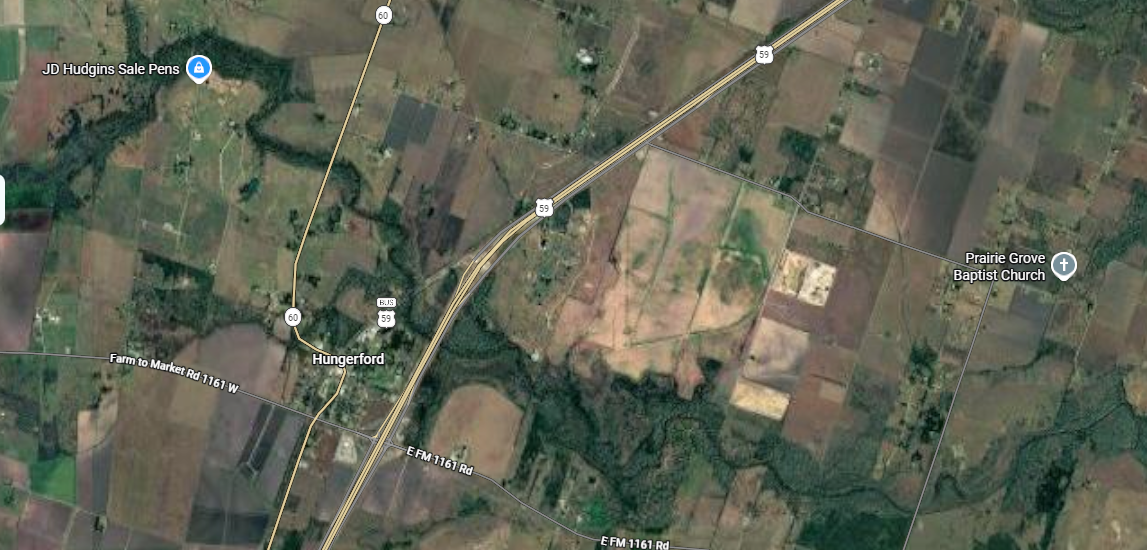
- 41WH14 was located about five miles west of Hungerford near Clark’s Branch and the West Bernard River. An archival report says the location served as both a seasonal occupation area and a cemetery.
- 41WH17 is identified in Houston Archeological Society records as a site in Wharton County. The public material reviewed by Wharton Post did not provide a more precise location.
- 41WH19 was located on the east bank of West Bernard Creek in eastern Wharton County. Researchers described it as a seasonal campsite used repeatedly over a long period.
- 41WH21 was located in eastern Wharton County on a wooded terrace near a small lake. Archaeologists described it as a seasonal campsite with evidence of occupation over thousands of years.
Exact coordinates and property-owner information are not included.
The federal notice says the four sites represent seasonal occupation spanning approximately 11,000 BCE through 1500 CE. That date range describes human activity across the sites and is not a specific date assigned to every individual whose remains were recovered.
Seven tribes identified
UTSA determined there is a cultural connection between the remains and funerary objects and the following federally recognized tribes:
- Apache Tribe of Oklahoma
- Cheyenne and Arapaho Tribes, Oklahoma
- Comanche Nation, Oklahoma
- Kiowa Tribe
- Mescalero Apache Tribe of the Mescalero Reservation, New Mexico
- Tonkawa Tribe of Indians of Oklahoma
- Tunica-Biloxi Indian Tribe
Repatriation may occur on or after Nov. 16, 2026, following the federal request process. The notice does not say that the remains have already been returned or identify which tribe or tribes will ultimately receive them.
If competing requests are submitted, UTSA’s Center for Archaeological Research must determine the most appropriate recipient before repatriation can proceed.
Sources
- Federal Register: Notice of Inventory Completion, Oct. 16, 2026
- Houston Archeological Society Journal No. 79 — 41WH14 report
- Houston Archeological Society Report No. 4 — 41WH19
- Houston Archeological Society Journal No. 116 — 41WH21 report
- Houston Archeological Society Journal No. 80 — 41WH16 photograph and separate 41WH14 article
Leave a Reply